*Note from the editors: All opinions expressed in the following piece are those belonging to the writer and not those necessarily held by the publication or by GRHS.
Generative AI (Artificial Intelligence), such as Chat-GPT, Microsoft Copilot, Google Gemini, etc., has weaseled its way into virtually everything. In nearly every office, work site, school, social media, and even a little pop-up on every Google search, AI is simply unavoidable.

Unsurprisingly, this constant slurry of AI has affected our brains—and not in a good way. Specifically, it has greatly impacted our critical thinking skills, which the increasing lack off has begun to rear its ugly head.
A study conducted by researchers at MIT’s Media Lab showed that participants who used AI while writing essays showed lower levels of brain activity as compared to groups who didn’t. Furthermore, when the group that had previously used AI to help write their essays was tasked with rewriting one of them without AI, they had trouble recalling what they wrote and had weaker brain waves.
Nataliya Kosmyna, one of the researchers in the study, said in an interview with TIME magazine when questioned about the group that originally used AI, “The task [writing the essays] was executed, and you could say that it was efficient and convenient. But as we show in the paper, you basically didn’t integrate any of it into your memory networks.”
These lower levels of brain waves shown in the study likely mean the brain is not putting the information that was gathered and created by AI into the deeper memory processes. This would explain why the AI group tended to have trouble recalling what they wrote, and the information was never fully processed.
I myself have also noticed these effects in my classes. There are some students who will use AI to do the vast majority of their work, who then go on to do terribly on tests and quizzes, as they have no grasp of the material. Because they simply enter their work into Chat-GPT or other similar LLMs (Large Language Models), the information and concepts simply never enter their deeper memory, which leads to their poor scores and understanding.
Another study, this time conducted by Micheal Gerlich at SBS Swiss Business School, showed similar results. Using a combination of both quantitative and qualitative measures to gather data among his 666 participants, all aged 17 and older, found that there was a strong negative correlation (r of -0.68) between AI tool use and critical thinking.
He also found a strong negative correlation (r of -0.75) between cognitive offloading— defined as the use of digital devices for memory and problem-solving tasks—and critical thinking. This coincided with him finding a strong positive correlation (r of +0.72) between AI tool use and cognitive offloading. These additional findings add validity to his and Kosymna’s studies, as well as my observations. This means that AI use leads to using digital devices to help you remember things or figure out a problem, which then results in less critical thinking.
These studies and observations show a simple, but terrifying cycle. It starts simply with someone who needs to hit a deadline—either for work or school—and maybe they don’t have the time or energy, so they use AI. Then they will brainlessly copy and paste the AI slop into their work and get it done, not processing it in their minds. Not remembering what to do, they might put their work into AI yet again, and the cycle will repeat, eventually leading to a reliance on AI.
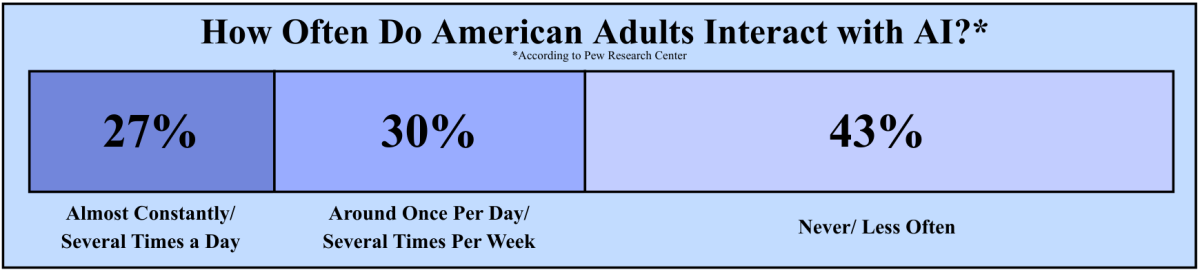
This reliance—ever so easy a trap to fall into—has already captured over a quarter of all Americans. According to Pew Research Center, 27 percent of Americans use AI almost constantly/several times per day, with another 30 percent averaging using AI several times a week.
“I have definitely seen it [use of AI] in my students who struggle with writing; I’ve seen them rely on AI to complete an assignment, which is unfortunate, because the assignments are based on personal experiences……. It [AI use] used to be here and there, but now it’s much more prevalent,” said Ms. Desmond when asked about her experience with students using AI.
Most frightening of all is that everyone currently affect have had at least some of their education pre-AI; however, it won’t stay that way. This begs the question: how will this impact the generation of kids who will grow up with AI ingrained in their world? Based on current research, it will most likely lead to an inability to think critically among Gen Alpha and Gen Beta. This will result in a future severely depleted of music, art, articles such as these, advances in academia, technology, science, and healthcare, along with solutions to intricate, complex, and/or unique problems.
Without critical thinking, we may go back to our medieval days of lacking innovation and thinking. Invented in 1440 and popularized in the 1500s, the printing press sparked the Renaissance, the greatest period of advancement in Western technology, science, culture, and art since the rise of the Roman Empire. A large part of this was due to the printing press, which gave people outside the clergy and nobility more access to printed materials, helping them learn how to read. It also allowed for famous scientists and artists to read and learn about previous works, as well as being able to write down and detail their own.
However, in the pre-printing press days, Western civilization was stuck in the medieval era, a dark age severely lacking in science, culture, literature, and art. A large contributor to dark age was the fact that people couldn’t read, which meant that they struggled to learn, understand, and interpret foreign concepts, ideas, and viewpoints or in layman’s terms, they couldn’t critically think.
And in its own way, generative AI is like the anti-printing press, keeping both books and their information out of people’s memories. As more and more people begin to rely on AI, they slowly start to lose the skills necessary to understand and think critically. Like a monarch banning reading to his peasants—who know none the wiser—AI is taking away our ability to think beyond surface level, which will likely put us into a new medieval-like era—at least when it comes to innovation.
While not based around AI taking over humanity’s minds, the movies Idiocracy (a satire of anti-intellectualism & consumerism) and WALL-E, (an animated movie depicting a world left a wasteland by consumerism and people sucked into technology none the wiser) paint, at least in my opinion, a solid picture of what the pitfalls of AI-reliance could lead us too: a wasteland filled with idiots, all too dumb to understand what they’ve done to Earth, why it matters, and unable to conjure up the ability to even think just an inch outside the box.
All in all, generative AI is an unavoidable cancer of modern society, plaguing the minds of everyone. Robbing them of our most vital skill as humans—critical thinking—we can almost be sure of the future having a decline in art, music, science, and technology. Simultaneously, we will have an increase in AI slop, corporations pursuing over our thoughts, and more and more people so dull that they can’t even do the simplest of math or reading comprehension without their soulless, heartless, and human-less AI assistant(s).