Not-so-fun fact: the majority of Americans read at below a sixth-grade level. 59 million adult Americans—roughly 28 percent of the population—scored at or below level 1 on OECD’s (Organisation for Economic Co-Operation) literacy portion of their Survey of Adult Skills.
It is defined that at this level, these adults can only understand short texts and organized lists with clearly indicated information—at most. Based on this, over a quarter of American adults struggle at understanding any text that doesn’t contain a distinctly clear meaning, as well as uncovering hidden(ish) meanings.
Take the novel Fahrenheit 451—a middle school/early high school classic that demonstrates the harm in anti-intelluctalism and government control—as an example. This book, which sits at around an 8th or 9th grade reading level, is currently unable to be properly understood by the majority of American adults.
Other middle or high school classics such as The Great Gatsby, Animal Farm, and The Adventures of Huckleberry Finn also fall into this category of not being able to be understood by the majority. These books, which many would consider incredibly helpful in understanding the world as you grow up, are now simply inaccessible and unattainable for the masses or worse: completely misunderstood.
What is in grasp, however, is social media—especially shorter-form platforms such as TikTok or Instagram. Not only do the short videos on these apps often lack any complex meanings, phrasings, or words, but they also severely reduce your attention span. Since virtually everyone owns both a smartphone and a social media account, this lack of an attention span is now a societal problem.
One of the numerous downsides of having a shortened attention span is that it makes it harder to read; reading of any kind is low-stimulating and is more difficult the less of an attention span you have. Due to this, the number of people who spend time reading leisurely has declined sharply, dropping to just 16 percent —about a sixth of the population —from a 28 percent high in 2004.
Not reading for leisure is a big reason why literacy is on the decline, as the vast majority of adults simply don’t read past what they are required to in high school and/or college. Literacy skills need to be consistently used to maintain or improve. Due to this, their skills in literacy are consistently in decline and show no signs of improving. While the emergence of audio and e-books has helped, the extremely strong presence of social media has done more harm than good.
The decline of newspapers has also contributed to this decline, as with fewer and fewer people reading the news, their literacy skills also decline. Instead of reading the news—something that takes literacy, critical thinking, and complex processing skills—people are instead turning to quick, short-form news sources that value entertainment and engagement and often lack the nuance and context that are necessary to properly understand current events.
Another example comes from a viral TikTok published a few weeks ago, where a student went around his high school, Preparatory Charter School, located in Philadelphia, and asked his classmates to read aloud this sentence:
She wore a silhouette of clothes that were extraordinary, but somewhat gauche.
The student then recorded five other students: all of them struggled with and didn’t know the word gauche; three struggled with and didn’t know extraordinary; three struggled with and didn’t know silhouette; one even saw the sentence and just gave up instantly.
After seeing this, I wanted to replicate this experiment at Gateway.
So, I did exactly that; I went up to a random selection of people and asked them to read aloud the previously mentioned sentence. I then asked them what the sentence meant. If they knew the words and understood the sentence, I marked it down as proficient in each category and non-proficient for the inverse. I also made sure to record my data in a way that participants could not be identified.
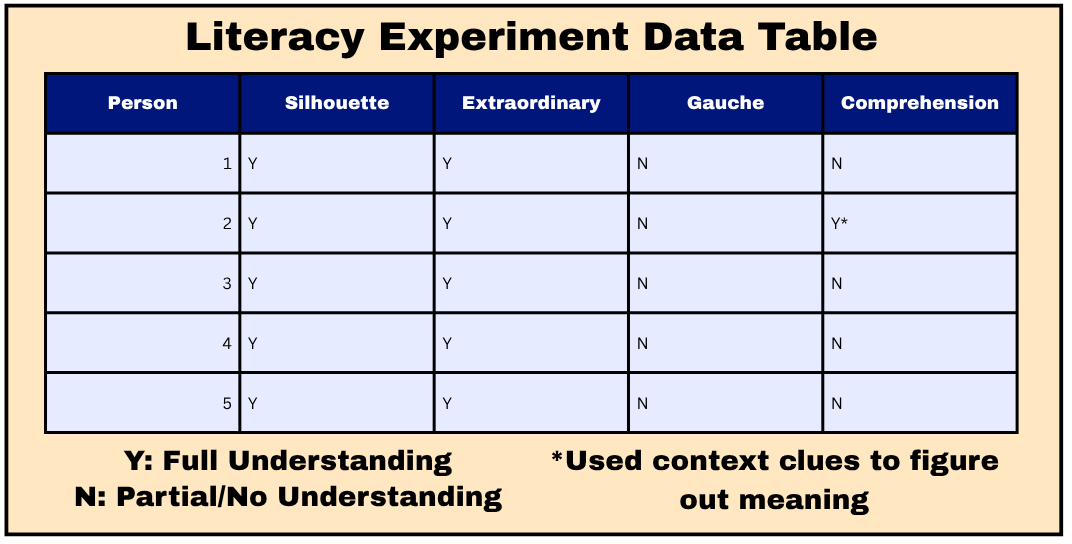
My experiment brought me unexpected results—in a good way. Everyone knew what silhouette and extraordinary meant. However, none knew the original meaning of gauche, nor how to pronounce it. Due to this, the vast majority (80%) did reach a complete understanding of the sentence. One participant, however, was able to piece together the meaning through context clues, so I gave them a mark for full comprehension.
It is important to note that my experiment had a smaller sample size, meaning that my data is not statistically significant nor fully representative of the Gateway population. If I had gotten the chance to ask every student this question, it would be nearly impossible that not one person would know what gauche meant or that everyone would know the meaning of extraordinary and/or silhouette.
But why did literacy rates—generally speaking— decline in schools?
Well (like many other problems in today’s education), it can trace its roots back to the No Child Left Behind Act (NCLB), which was passed in 2002. This act forced public schools nationwide to both create and test their students on standardized state tests, as well as report their scores. These scores were then used to allocate funding to these schools.
But the problem came with how they allocated it: schools still received funding on a “need” basis, however, schools that did not show yearly improvement in testing scores would receive sanctions on how much funding they would get. While this was done to force schools into focusing on these tests—which it did—it also disproportionately punished schools in poorer areas.
There is already a pre-existing negative effect that poor income has on education and literacy; schools with low funding have lower graduation and literacy rates, as well as test scores, than those with higher funding nationwide. This effect, now coupled with NCLB, created a negative death spiral for literacy rates among students located in lower-income areas, which make up 30 percent of where all Americans live. In other words, one in three students is negatively impacted by NCLB due to the added stranglehold it puts on lower-income area schools.
But for the upper 70 percent, such as Gateway, NCLB didn’t exactly bring all the benefits. As I mentioned previously, it forced schools to focus on doing well on state tests, which doesn’t exactly translate to having high literacy rates.
While this is strictly anecdotal evidence, the passages and questions on standardized state tests are often very surface-level, meaning that what schools are teaching their students to understand is just the base level—also known as literacy level one (maybe level two) or below. By teaching students to just analyze the base level, they often never learn how to analyze a text more deeply. Without being taught how to get a deeper understanding and analysis of the texts, students’ literacy skills have suffered greatly.
Now, this isn’t the fault of the teachers; it’s the fault of the educational boards at the state and federal levels. It’s not that teachers don’t want to give their students a deeper education and understanding of the world (they clearly do), but how their students’ performance on these state tests determines whether or not they’ll have a job. And since their livelihoods depend on these test scores, teachers are forced to teach their students to do well on these tests, which often comes at the expense of other valuable skills and lessons.
This is the very reason why so many fewer books are being read in schools, as many teachers simply do not have the time and/or freedom to dedicate their class time to anything other than state testing skills. Not only does not reading have a direct correlation to low literacy, but it also robs students of the chance to, with help (if needed), read classic books, such as the ones I previously mentioned.
Another pivotal reason for this decline in literacy comes from the lack of phonics instruction in schools.
Phonics—for anyone who doesn’t know—is the method for teaching someone how to read by teaching them the individual sounds of letters and certain letter combinations, such as “sh” or “th.” What this does is it gives children the ability to “sound out” the word(s) they do not know.
However, over the last two decades, the method of “sight reading” has taken over, which is based on the immediate recognition of words through rote memorization. While sight reading sounds fine in theory, it presents a massive problem: no one can sound out words anymore.
Both my study and the TikTok on which I based it are perfect examples of this. Specifically, the way in which people who didn’t know what the word gauche meant tried to figure out its meaning and pronunciation is a perfect example of this.
The ones who had received a background in phonics tried to sound out the word and often had a better understanding of what the word meant, while those with a sight reading background often did not have a clue where to begin. Since sight reading is based entirely on memorization, an unfamiliar word can completely stump someone and force them to freeze up.
On the other hand, since phonics are the “building blocks” of language, someone with that background would at least have a general idea of what an unknown word sounds like and means. Without phonics, it makes it much harder for children to read—especially more advanced texts. These advanced texts are what make up that higher level of literacy, which allows for the understanding beyond the most basic level of information. Without these skills, people are stuck, not being able to read, which creates a more confusing, complicated, and easily misled life.
But there is some hope for the future: schools are now turning back to phonics. Over the last few years, certain states, such as New Jersey, Illinois, and Georgia, have adopted the use of the “science of reading,” which includes the extensive teaching of phonics, in their classrooms.
In conclusion, America’s literacy crisis is caused by a complex web of educational administrators at the state and federal levels favoring analytics over trusting teachers. While this “moneyball” strategy of analytics might have worked very well for the 2001 Oakland Athletics, it certainly has not worked out for Americans at large. That, along with the many cultural and societal factors—phones, social media, decline of newspapers, growth of video news, etc.—has compounded with our phonics-less educational systems to the point where no one knows how to read.